


Word Solitaire Go
4.9164.00 Reviews
App Specs
- Version
- 1.1.5
- Updated On
- License
- Free
- Downloads
- 500,000+
- Developer
- Nebula Studio
- Categories
- Word
- Platform
- Android
Screenshots
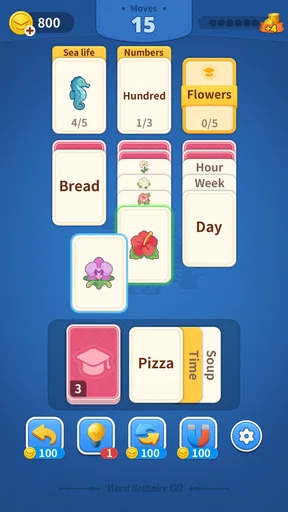
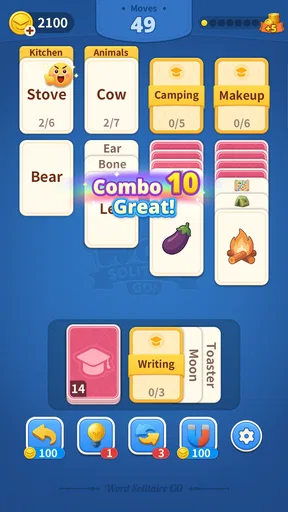
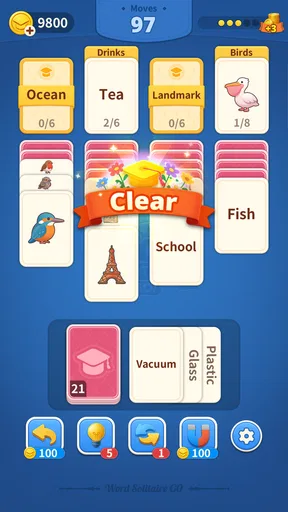

 Analysis by AppCompare
I like word puzzles best when they fit into a small pocket of the day rather than demanding a long, uninterrupted session. Word Solitaire Go is aimed at that kind of play: it combines arranging words into groups with a solitaire-like puzzle rhythm, making it a gentle option when I want to focus without turning a break into a high-pressure challenge. Its appeal is the mix of word recognition and orderly sorting, not a sprawling story or a competitive ladder.
That distinction matters when deciding whether to try it. This is a free word game from Nebula Studio, with an Everyone age rating. It has a 4.9 average from around 5,000 ratings and has passed 500,000 installs. Those figures suggest broad interest, but they do not tell me whether its particular puzzle style will suit you; the useful question is whether you enjoy slowly untangling words and groups.
What the free entry point gives you
I see the free starting point as a chance to test whether this particular kind of word sorting suits you, without paying upfront. I’d use that first session to notice whether comparing possible groups feels satisfying or fussy; that distinction is more useful than guessing how much play you’ll want later. From there, the next question is what makes the puzzle worthwhile when it clicks.
A low-cost way to test the puzzle style
You can start without paying, so there is no purchase price to weigh against the basic idea. That makes the trial decision simple: if sorting words into groups sounds satisfying, you can see whether the play feels right before considering any spending. The game is listed with in-app purchases ranging from $0.99 to $99.99 per item, so free access should not be mistaken for a promise that every optional purchase is equally small.
I would treat those purchase prices as a reason to pause before tapping any buy button, not as a reason to assume payment is necessary. The available price range alone does not explain what each item does or whether any particular purchase improves a puzzle session. If you prefer games with a clearly stated one-time price and no optional spending, this model may be less comfortable than a paid word-puzzle alternative.
The practical approach is to play first and decide later. If the puzzles hold your attention without prompting you to spend, the free entry point may be all you need. If you find yourself considering an item, check its displayed price and purpose in the game before confirming; the range includes both small and substantially larger amounts.
Where the value comes from
The core value is mental activity in a calm format. Instead of asking you to race through a word grid, the solitaire-style setup frames the task as a sequence of decisions: identify a useful word, see how it relates to the others, and work toward a coherent group. That structure gives each move a little more purpose than simply spotting another word on a page.
Worth Reading Before You Choose

EA SPORTS FC Mobile 26 Is a Bigger Football Game, but It Takes Time

Flipboard Shows What News Apps Must Do Beyond the Feed

Switching to Android Auto Means Rethinking Your Driving Routine

Google Calendar Makes a Crowded Week Easier to Manage

Ludo King Makes the Most of the Minutes Between Plans

Baby Panda World Brings Quick Play to Modern Phones, but Its Game Library Feels Busy
For me, the best use case is a short pause when I want something more engaging than scrolling but less involved than starting a long game. A few minutes between errands, a quiet moment with coffee, or a wind-down before putting the phone away all fit the general pace implied by this kind of puzzle. I would not use it as a substitute for a timed brain-training routine, though: its attraction is relaxed sorting, not a measurable workout.
There is also a useful middle ground between word searches and category quizzes. A word search usually rewards scanning for visible letter sequences; a category puzzle often asks you to name or identify a set directly. Here, arranging words into groups gives you room to reconsider relationships as you go. That can make it more reflective than a search grid, while still keeping the task concrete.
One practical tip is to avoid treating the first plausible grouping as automatically correct. When several words seem related, pause and compare them with the remaining choices; a narrower connection may be more useful than a broad association. This kind of deliberate checking is a good fit for the format and can keep a relaxing puzzle from becoming random trial and error.
Tradeoffs before you settle in
The same focused format can become a limitation. If you want a large variety of modes, a narrative campaign, head-to-head play, or a steady stream of new mechanics, the short description of this game does not point toward those as its main attraction. I would choose a broader word-game collection if variety between sessions mattered more to me than the simple pleasure of sorting words.
Another tradeoff is that relaxed pacing will not satisfy everyone. Players who enjoy strict time limits, score chasing, or visible competition may find a solitaire-like word puzzle too quiet. Conversely, someone who wants a completely frictionless activity may not enjoy having to think through ambiguous word relationships. The satisfaction depends on liking the small moment of uncertainty before a group clicks into place.
It is also worth keeping expectations realistic about the value of a high average rating. The game’s 164 written reviews add individual opinions, but neither reviews nor ratings can establish that its puzzle style matches your taste. I would use the free access as the better test: give it a few sessions, notice whether the sorting feels absorbing or repetitive, and make a spending decision only if you can identify a specific reason.
The game is listed at version 1.1.5 and requires Android 7.1 or later. That is useful if you are checking compatibility before downloading, especially on an older device. It is a practical detail rather than a reason to expect a particular level of performance; your experience can still depend on the phone or tablet you use.
Who is likely to get the most from it?
I would recommend giving it a try if you like vocabulary puzzles but sometimes find conventional word searches too mechanical. It should also appeal to people who enjoy grouping ideas, sorting a cluttered set of choices, and taking a puzzle one decision at a time. The free starting point makes it especially easy to test during an ordinary break rather than committing to a purchase in advance.
It may be a poor fit if your priority is multiplayer competition, an elaborate progression system, or a game you can finish in one sitting with a clear ending. It is also not my first pick for someone who dislikes optional in-app purchases on principle. The existence of items priced as high as $99.99 makes careful checking important, even though the game itself is free to start.
For a household with different ages, the Everyone content rating makes the game broadly approachable from an age-classification perspective. That does not mean every player will enjoy the same challenge or that an adult should assume all purchase choices are suitable without checking them. I would still treat spending controls as a separate decision, especially if a child may use the device.
A sensible way to judge its value
My recommendation is to measure value by whether the basic puzzle loop earns a place in your routine. Try it when you have a few spare minutes, rather than setting aside a whole evening. Notice whether you naturally want to solve one more group, or whether the sorting starts to feel like busywork. That reaction tells you more than the headline rating does.
If you enjoy the activity, keep playing for free unless a clearly explained optional item addresses something you actually want. If the game’s purchase prompts or the listed price range make you uneasy, there is no need to force a purchase: a traditional word search, a category quiz, or a one-time-paid puzzle may suit your preferences better. Those alternatives trade the solitaire-like sorting experience for a different structure, so the best choice depends on what you want from a short session.
How it fits into an ordinary day
One realistic way I would use it is during a wait that is long enough to be dull but too short to start a bigger game. I might open it while waiting for a ride or sitting in a quiet waiting room, solve a few word groups, then put the phone away when the moment ends. That is where the compact premise makes sense: I can give a puzzle my attention without needing to remember a plot or return to a complicated objective later.
For a better first impression, I would try it at a time when I can concentrate a little rather than while multitasking. Grouping words asks for attention to meaning, and trying to solve while answering messages can make a modest challenge feel irritating. If I am tired, I would also give myself permission to stop after a group instead of forcing a longer session. A calm puzzle only stays calming when I choose the pace.
There is a useful distinction between using it to fill a gap and relying on it for sustained play. If you want an activity to occupy an entire evening, this focused loop may not offer enough variety. But as a small recurring ritual—one short session after lunch, for example—it may be more appealing precisely because it asks for less commitment. I would judge it by whether I return to it naturally, not by how long I can keep playing in one sitting.
Ways to make the sorting less frustrating
When a group seems obvious, I would check whether the other words support that reading before committing to it. Words can share a broad association while belonging to a more specific set, so testing a tentative connection against the whole collection is more reliable than building around the first idea that comes to mind. This is not a hidden feature; it is simply a more thoughtful way to approach the sorting challenge.
I would also separate “I recognize these words” from “I understand the relationship the puzzle is asking for.” Familiar vocabulary can create false confidence, especially when several terms have overlapping meanings. If a grouping stalls, stepping back and looking for a common context rather than a shared definition can give you a fresh angle. That small change in approach is likely to matter more than rushing through guesses.
For anyone sharing a device, it is sensible to keep puzzle time and purchase decisions separate. A younger player can enjoy the word challenge while an adult checks any item’s price and purpose before approving a transaction. That practical boundary follows from the range of optional purchases, not from any assumption that spending is required to play.
What to expect from the alternatives
Compared with a classic word search, this game puts more weight on relationships among words than on locating letters in a grid. If you enjoy scanning and finding hidden spellings, a traditional search is the more direct choice. If you like sorting and reconsidering how terms connect, the solitaire-style format has a different kind of small payoff. Neither approach is automatically better; they ask for different habits of attention.
A category quiz is another reasonable alternative, but it tends to make the task feel like answering a prompt or identifying a set. Here, the pleasure is more in arranging and testing the group as you work. A broader collection of word games may be preferable if you get bored repeating one central activity, while a fixed-price puzzle could be a better fit if you want to avoid optional purchases entirely. I would choose based on the structure I actually want, rather than expecting this game to replace every word-puzzle format.
That comparison also helps set expectations for difficulty. The value is not necessarily in having a timer or a competitive score to push against; it is in the judgement involved in finding a sensible grouping. Players who need an external goal may find the experience understated, while people who enjoy a quiet reasoning task may appreciate not having to chase a leaderboard. If your ideal puzzle is a fast test of reflexes, this is probably the wrong direction.
My buy-or-skip verdict
Word Solitaire Go is worth trying as a free word-puzzle game if you enjoy patient grouping more than speed, competition, or a story-driven campaign. Its value rests on whether arranging words gives you a satisfying little pause in the day, not on a promise of endless modes. I like the focused premise, and the no-cost starting point lowers the risk of discovering that it is not for me.
I would skip optional spending until you know what an item offers and why you want it. The game can be a sensible choice for casual puzzle fans who are comfortable with in-app purchases being present, but less appealing to people who want a fixed all-in price or a wider range of activities. If word sorting sounds relaxing rather than tedious, try a few sessions and let that experience—not the rating alone—decide whether it deserves a spot on your phone.
Pros
- Combines familiar solitaire rules with a word-building twist.
- Short rounds make it easy to play during a quick break.
- Word challenges can help keep vocabulary practice engaging.
- A simple card-game format is easy to pick up.
- Offers a different feel from standard solitaire apps.
Cons
- The word twist may not appeal to players seeking classic solitaire.
- Some puzzles may feel repetitive over longer play sessions.
- A limited vocabulary can make certain challenges frustrating.
- Progress may depend on how familiar you are with word games.
- Card and word-game fans may prefer more control over difficulty.
FAQs for Word Solitaire Go
What is Word Solitaire Go?
Word Solitaire Go combines familiar solitaire-style card play with word puzzles. Instead of only sorting cards by suit or number, you use letters and vocabulary clues to complete word challenges. It is designed for players who enjoy both casual card games and brain teasers, though the exact mix of modes and features can vary by version. Check the app listing and in-game instructions to see which options are available on your device.
How do you play Word Solitaire Go?
The basic idea is to work through a solitaire-like layout while using letter cards or related clues to form words and meet each puzzle’s objective. Rules can differ between levels, so it is worth reading the tutorial before starting a challenge. You may need to plan moves carefully, since using a card in one place can affect what becomes available elsewhere. The game is generally suited to short, pick-up-and-play sessions.
Is Word Solitaire Go free to download and play?
The app may be available to download without an upfront purchase, but that does not necessarily mean every feature is free. Depending on the current version, it may include advertising, optional in-app purchases, or other monetized extras. Review the Google Play or App Store listing for the latest pricing details, and check your device’s purchase settings if children may use the app. Store terms and availability can change by country.
Can I play Word Solitaire Go offline?
Offline access depends on the app version and which features you want to use. Core puzzles may be playable without a connection, while advertisements, purchases, daily challenges, cloud saves, or other online services may require internet access. If offline play matters to you, test the game after it has finished installing and loading its initial content. Also check the store description for any stated connection requirements before downloading.
Is Word Solitaire Go suitable for beginners, and what should I check before downloading?
Its combination of word puzzles and solitaire-style mechanics can be approachable for casual players, but the challenge may increase as you progress. Beginners can use the tutorial and take time to understand how moves affect the layout; players looking for a traditional solitaire game should note that the word-solving element changes the experience. Before downloading, check device compatibility, recent user reviews, permissions, available languages, and the current listing for ads or in-app purchases.


